
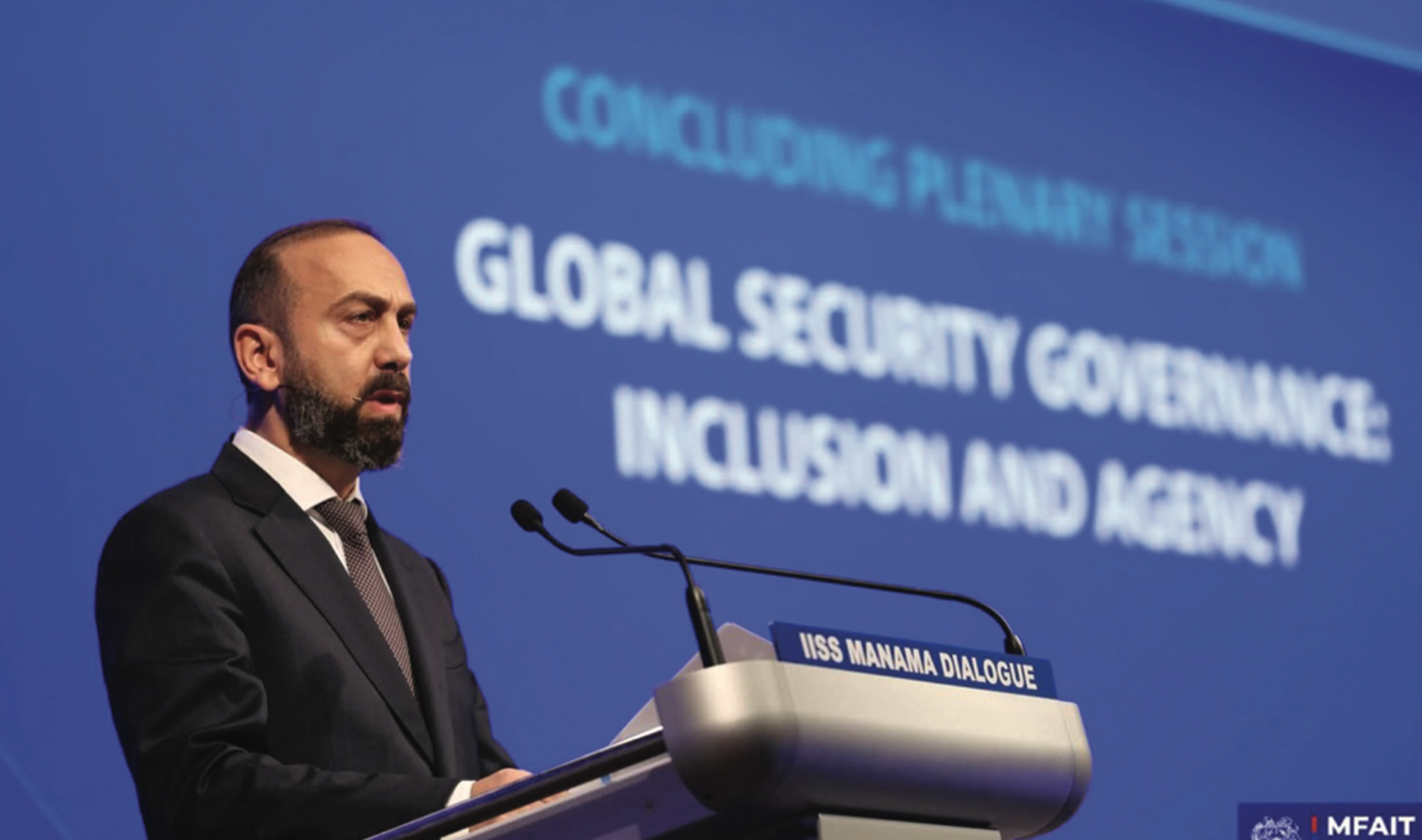

Armenia has made a strategic choice in favor of lasting peace, stronger regional cooperation and greater intercon- nectedness, Minister of Foreign Affairs and International Trade of Armenia Ararat Mirzoyan said during the closing plenary session of the Manama Dialogue forum on Novem- ber 1. Addressing the session titled “Global Security Gover- nance: Inclusion and Agency,” Mirzoyan said a country’s international role should not be measured solely by its ter- ritory, population or economic capacity, but also by the role it chooses to play in its neighborhood and the wider interna- tional arena. “Regardless of its resources, every state has the capac- ity to contribute to cooperation or to deepen divisions, to serve as a bridge between nations or as a source of further fragmentation,” he said, emphasizing that such choices are ultimately a matter of political will. Mirzoyan stressed that Armenia’s decisions are guided by a firm commitment to peace, the advancement of cooper- ation and a shared responsibility to build a more secure and prosperous future. He described the August 8, 2025, Washington Peace Summit as a historic milestone in advancing peace between Armenia and Azerbaijan. At the summit, the leaders of Ar- menia and Azerbaijan, with the US President as a witness, signed a Joint Declaration, while the foreign ministers of the two countries initialed the Agreement on Establishment of Peace and Inter-State Relations. According to Mirzoyan, the achievement opened a new chapter and created opportunities to transform the South Caucasus from a region marked by confrontation into a space of dialogue, cooperation and shared prosperity. He emphasized that political commitments must be ac- companied by concrete actions and tangible results, adding that connectivity projects should generate mutual benefits not only for countries in the immediate region but also for international partners. In this context, Mirzoyan highlighted Armenia’s Cross- roads of Peace initiative, describing it as an inclusive vision that is particularly relevant amid global efforts to diversify transport routes and strengthen connectivity. He also pointed to the TRIPP project, which envisages railway, electricity, fiber-optic, oil and gas infrastructure on Armenian territory. The project is expected to strengthen connectivity not only between Armenia and Azerbaijan and their immediate neighborhood, but also between East and West and North and South, creating new opportunities for regional and interregional trade and contributing to the resil- ience of international supply chains. The Armenian minister also emphasized the importance of strengthening state resilience in an increasingly complex international environment through diversified international partnerships, expanded economic opportunities and greater economic diversification. Citing S&P assessments, Mirzoyan noted that Arme- nia’s average economic growth in 2022–2025 stood at 7.8%, among the highest rates among the 143 countries rated by the agency. He also reported that economic activity grew by 8% year-on-year in the first five months of 2026, while the economic activity index increased by 7.7% in January–July. Mirzoyan further highlighted Armenia’s interest in de- veloping relations with Gulf countries, particularly through expanding trade, promoting mutual investments and identi- fying new areas of mutually beneficial cooperation. Concluding his remarks, he invited participants to attend the next edition of the Yerevan Dialogue, scheduled for May 2027. Recalling the themes of the previous forums — “Nav- igating the Unknown” in 2025 and “Riding Through the Storms” in 2026 — Mirzoyan expressed hope that the inter- national community would see greater stability and predict- ability in the Middle East by the time of the next gathering, alongside renewed prospects for dialogue and lasting peace. “The storms are real. But so is our choice. We can let them drive us apart, or we can choose to ride through them together, creating stronger bonds and functioning cross- roads,” he said. Mirzoyan concluded that for smaller states to have their voices heard and respected, effective multilateral mecha- nisms must be accompanied by a clear national vision, mutu- ally beneficial partnerships and sustained efforts to achieve their goals.