
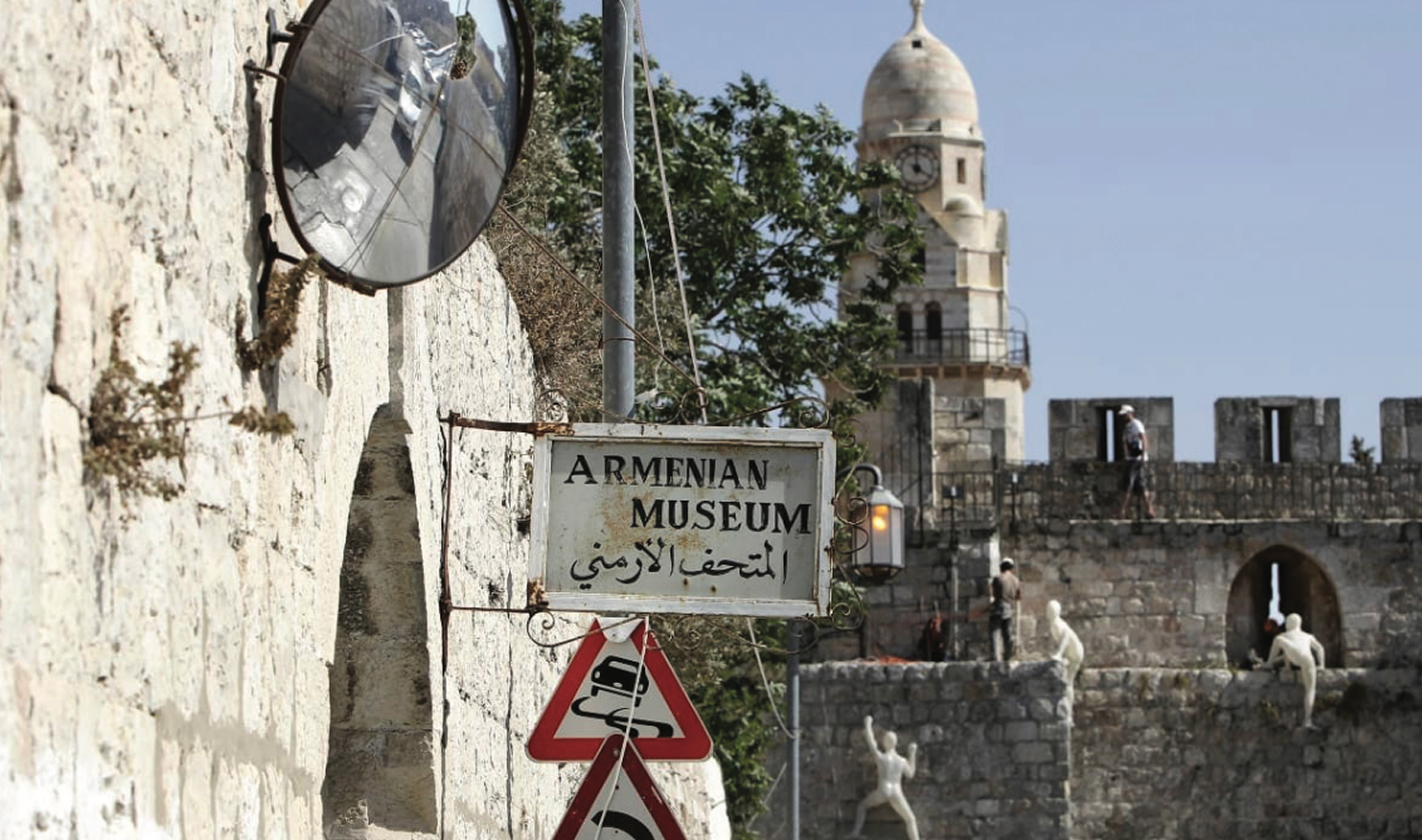

For decades, the Armenian community of East Jerusalem has endured harassment, intimidation, and discrimination by extremist haredi (ultra-Orthodox) and nationalist Jewish youths.
BY BEDROSS DER MATOSSIAN
THE JERUSALEM POST
Imagine Armenian youths walking daily past the Western Wall and routinely spitting on rabbis entering or leaving the site, desecrating Jewish holy places, or throwing stones at homes in the Jewish Quarter. How would the Israeli government, police, and public opinion react? Obvi-ously, there would likely be swift arrests, prosecution, and strong condemnation.
That is precisely the double standard Jerusalem’s Armenians say they have lived with for years.
The Wall Street Journal’s recent investigation into rising anti-Christian hostility in Jerusalem has now brought a sense of justified urgency and unprecedented international attention to what the Armenian community has long experienced firsthand
The latest disturbing incident – in which six ul-tra-nationalist religious Jews spat on the sacred entrance of the Cathedral of St. James in the Armenian Quarter and threw stones at Armenian homes – once again highlights what many members of the Armenian community perceive as a climate of impunity in which such offenders operate.
For decades, the Armenian community of East Jerusalem has endured harassment, intimidation, and discrimination by extremist haredi (ultra-Or-thodox) and nationalist Jewish youths. These incidents have included spitting on clergy, desecrating religious sites, verbal abuse, physical assaults, and other forms of intimidation. Owing to the Armenian Quarter’s location adjacent to the Jewish Quarter, Ar- menians have become one of the most vulnerable Christian communities in Jerusalem’s Old City. The persecution they face includes repeated harassment, at- tacks on Armenian youths, desecration of churches and religious property, and other forms of religiously motivated hostility. We should not generalize: these ac- tions do not reflect the views of all Is- raelis. After several widely publicized incidents, many secular Israelis and civil society groups have shown soli- darity with the Armenian community, condemned the attacks, and made clear that they disapprove of the attitudes and actions of the extremist individu- als responsible. Israel possesses legal protections for religious minorities through its Basic Laws, judicial decisions, and ordinary legislation. But none of these Basic Laws explicitly guarantees mi- nority rights. Protection for minori- ties exists primarily through the Ba- sic Law: Human Dignity and Liberty (1992), Supreme Court jurisprudence, and ordinary legislation. The question is how effectively even this level of protection is imple- mented in practice. For decades, following incidents in the Armenian Quarter, Israeli police
have arrested suspects and taken them to the police station near the Armenian Quarter. Since much of the area is covered by surveillance cameras, the authori- ties are generally able to determine what occurred. But those responsible are usually released shortly afterward. In many cases, they reportedly receive only warnings or temporary restric- tions preventing them from entering the Old City or Jerusalem for a limited pe- riod. Following the most recent incident, the suspects were reportedly barred from entering Jerusalem for only 15 days. It is becoming increasingly clear that this approach has failed to deter repeat offenses. Many perpetrators appear to believe that they face few meaningful con- sequences for their actions. Adding to the concerns, Israel’s current political climate, characterized by the strong influence of nationalist and right-wing parties, has led many observ- ers to worry that extremist settlers and ultra-nationalist groups feel increasingly emboldened. Indeed, these are not merely isolated incidents involving a handful of indi- viduals but rather part of a recurring pattern involving extremist religious and settler activists whose actions make life increasingly difficult for Jerusalem’s Armenian community.
ISRAEL’S TEST The Israeli government’s failure to adequately remedy this situation has un- derstandably raised concerns within the Armenian community about its com- mitment to protecting vulnerable minorities, and the persistence of these attacks raises serious concerns about the adequacy of law enforcement and deterrence of what has become a sustained pattern of harassment, intimidation, dehumaniza- tion, and attacks against a historic religious minority. When perpetrators consistently avoid accountability, the likelihood of repeat- ed violence increases as the perception of impunity encourages further incidents. Moreover, this is about more than the Armenian community. Even some of Israel’s closest friends – including prominent evangelical Christians in the United States – have begun questioning whether the country is doing enough to protect its Christian communities. Israel prides itself on being the Middle East’s only liberal democracy and on safeguarding the holy places of the three great monotheistic faiths. That claim is weakened every time clergy are spat upon, churches vandalized, or worshipers intimidated with little consequence for the perpetrators.
SO WHAT SHOULD PRACTICALLY BE DONE? The Israeli government, and the police in particular, should adopt more ef- fective measures to eliminate this phenomenon. Existing laws protecting public order, religious freedom, and against hate crimes should be enforced consistently and vigorously. Where current penalties prove insufficient to deter repeat offenders, policy- makers should consider strengthening legal sanctions. Meaningful criminal pen- alties – including imprisonment in serious cases – as well as financial compensa- tion for victims where appropriate, would send a clear message that religiously motivated harassment will not be tolerated. I also call upon the United Nations Human Rights Office (OHCHR), Human Rights Watch, Amnesty International, B’Tselem, the Association for Civil Rights in Israel, and other human rights organizations to investigate these recurring in- cidents, monitor developments closely, and advocate for stronger protection of Jerusalem’s Armenian community. There is a responsibility on the part of the world’s media as well. If similar in- cidents occurred in cities such as Los Angeles, Toronto, or New York, they would likely receive extensive national and international media attention. Yet compa- rable incidents in Jerusalem’s Old City often receive relatively limited coverage. Amid the war in Gaza, increasing settler violence in the West Bank, and broader regional tensions, the ongoing harassment of Jerusalem’s Armenian community has largely remained outside international public attention. Israel has both a legal and moral responsibility to protect all communities under its jurisdiction, including religious and ethnic minorities. The current situ- ation raises serious questions about whether sufficient protection is being pro- vided to vulnerable groups in East Jerusalem. The answer is a resounding no. Jerusalem remains one of the world’s most contested cities. The Armenian community in it faces a genuine existential challenge. Its population has steadily declined over the past several decades, raising concerns about its long-term fu- ture in the city. Preserving this ancient community is essential not only for the Armenians but also for safeguarding Jerusalem’s unique religious, cultural, and historical diversity for future generations. This is a test of whether Israel intends to uphold the principles of religious freedom and equal protection that it rightly says distinguish it from its neighbors. The writer was born and raised in the Old City of Jerusalem. A Guggenheim Fellow, he is professor of Modern Middle East history and Hymen Rosenberg Professor in Judaic Studies at the University of Nebraska, Lincoln. He is also the Director of Genocide Research at the Zoryan Institute.