
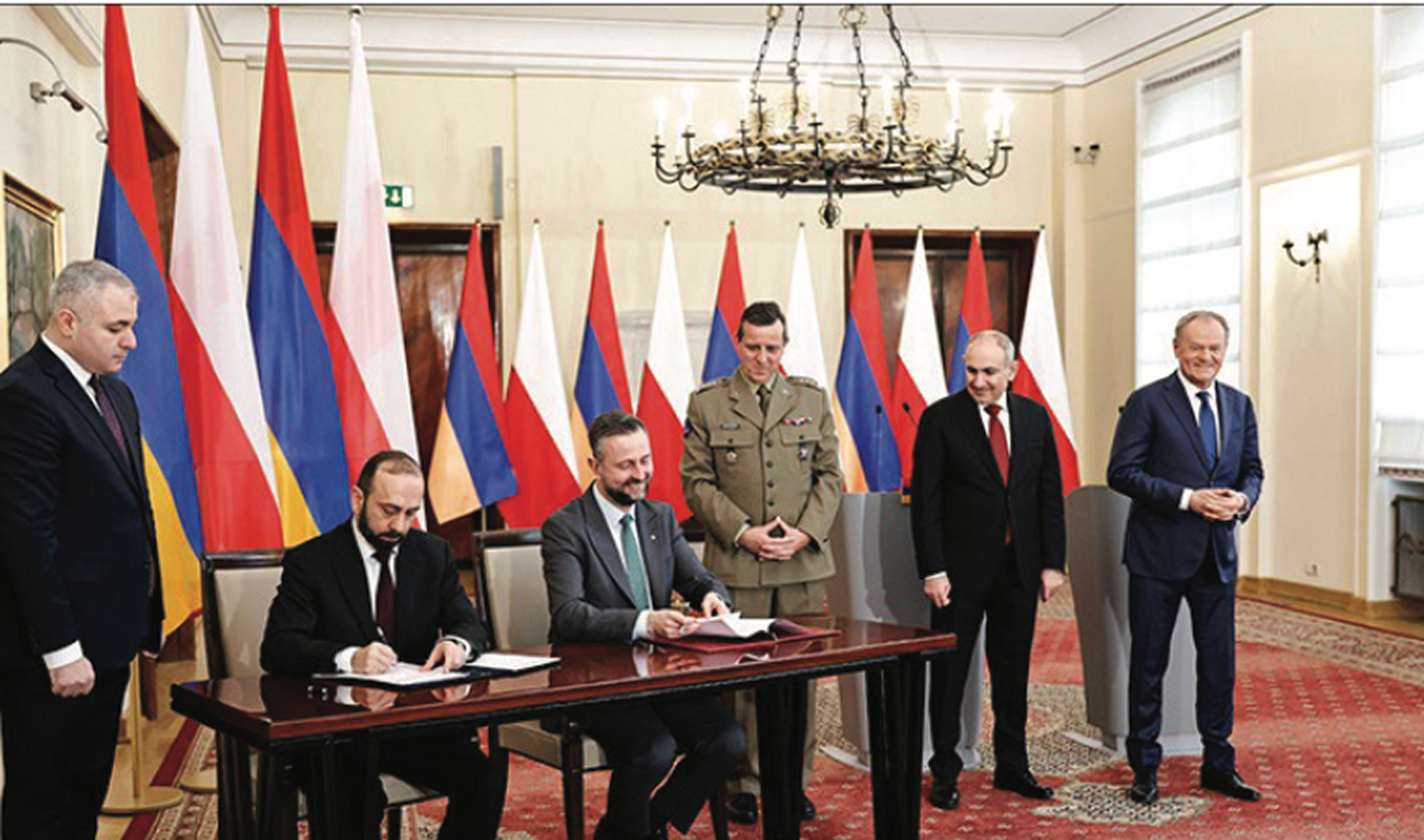

WARSAW — During Prime Minis- ter Nikol Pashinyan’s visit to Warsaw, Armenia and Poland signed a military- technical cooperation agreement. No specific details were disclosed. At the conclusion of the talks, Polish Prime Minister Donald Tusk highlighted the significance of the agreement, again without elaborating. “We believe that the military coop- eration carried out in the field of our security will be beneficial not only for Armenia, but for the entire region. We fully understand how important this is. Both countries—and both of us as prime ministers—clearly know what to do and how to do it so that we are not alone, so that we stand together and ensure stable security for our countries and our peoples,” Tusk said. The Polish prime minister, who previously served as President of the European Council for five years, noted that the European Union’s doors re- main open to Armenia, which has cho- sen the path of democracy. Prime Min- ister Pashinyan, for his part, recalled that Armenia’s parliament has adopted a law to begin the process of accession to the EU. However, Yerevan has not yet submitted a formal application to Brussels. “An attempt is being made to cre- ate the impression that being a demo- cratic country means being a weak country—that a democratic country is incapable of ensuring and defend- ing its own security. I believe Poland is a vivid example of how democracy can be combined with a strong secu- rity system, a strong economy, and, of course, strong international partner- ships,” Pashinyan said. The prime minister’s visit to Po- land began on Wednesday. He met with representatives of the Armenian community, visited the Institute of International Relations, presented the Armenian-Azerbaijani normalization process, and spoke about the “Trump route.” Polish experts were particular- ly interested in developments regard- ing Turkey. “We had a very positive dialogue with Turkey. We constantly hold meet- ings and consultations. However, the most important event we hope to see is the establishment of diplomatic re- lations—official diplomatic relations between Armenia and Turkey—and, of course, the opening of the land border. Why do I specifically mention the land border? Because the air border is already open. We have regular flights from Armenia to Turkey, and I expect the volume of bilateral flights to in- crease. “Of course, we hope the land bor- der will open, and incidentally, we will need new infrastructure at the border with Turkey. We are currently discuss- ing how the European Union can sup- port us in this matter. I am confident that the process is unfolding, and we will soon see progress. At the very least, the atmosphere and the tone of our relations are very conducive. At present, we have no issues within that framework. There appears to be a shared understanding that this should happen, but, of course, it depends on Turkey’s decision, since there are no obstacles on the Armenian side. We are ready to proceed at any moment,” the prime minister stated. Pashinyan also reiterated that Ar- menia is prepared to provide transit passage from Turkey to Azerbaijan and in the opposite direction. In Warsaw, the prime minister fur- ther stated that there are no plans to withdraw the Russian military base from Armenia, though he added that Armenia’s participation in the CSTO has been frozen.