
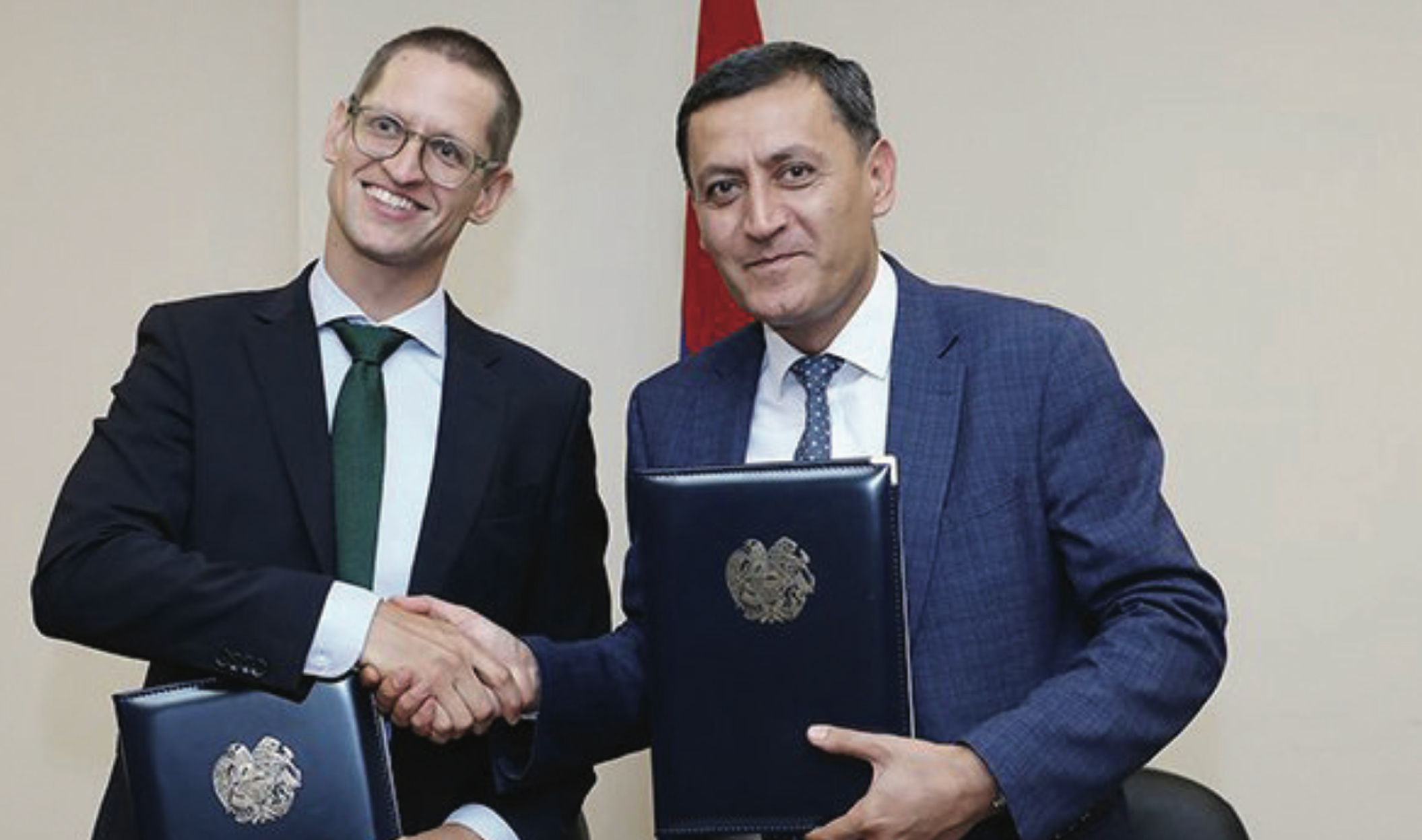
YEREVAN — Armenia’s Ministry of Education, Science, Culture and Sports and the Armenian branch of the Goethe-Institut have signed a memo- randum of understanding aimed at ex- panding cooperation in language edu- cation and cultural initiatives. Under the memorandum, the Goethe-Institut will support the devel- opment of German-language education in Armenia and contribute German ex- pertise to the creation of a standardized Armenian-language proficiency test- ing system. The document was signed by Ar- menian Deputy Minister of Educa- tion, Science, Culture and Sports Artur Martirosyan and Jan-Tage Kühling, Director of the Goethe-Institut in Ar- menia. Siranush Dvoyan, Chair of the Ministry’s Language Committee, also attended the ceremony. Martirosyan welcomed the signing of the memorandum and praised the Goethe-Institut’s activities in Armenia, as well as the expansion of Germany’s cultural and educational presence in the country. Noting the transformation of the former Goethe Center into a full- fledged Goethe-Institut, Martirosyan emphasized the institution’s contri- bution to promoting the German lan- guage and culture in Armenia and to strengthening Armenia-EU relations in the cultural sphere. According to the deputy minister, the Goethe-Institut has also assumed a coordinating role among the cultural branches of European diplomatic mis- sions in Armenia and is actively coop- erating with the ministry to advance Armenia-EU cultural ties. Martirosyan particularly highlight- ed the Goethe-Institut’s contribution to creating a unified system for assess- ing Armenian-language proficiency in accordance with the A1-C2 levels of the Common European Framework of Reference for Languages (CEFR). “This is an extremely important objective for us. Drawing on the expe- rience of various European languages, we are currently developing a unified proficiency assessment system, and with the support of the Goethe-Institut, we will study leading German practic- es in this field,” Martirosyan said. He said the importance of such a system could hardly be overstated, giv- en Armenia’s large diaspora, the coun- try’s ambitions to attract international students, and the need for measurable and comparable language-proficiency assessments in migration policy and other areas. Martirosyan also identified youth policy as another important area of co- operation, noting that Goethe-Institut initiatives contribute to reforms in var- ious sectors, particularly youth affairs, and help bring Armenian practices closer to European standards. As part of its cooperation with the ministry, the Goethe-Institut will or- ganize professional development and training courses for German-language teachers. The two sides also plan to conduct regular joint assessments of existing needs, coordinate planned activities and training programs, and support public-awareness efforts aimed at dis- seminating information about profes- sional development opportunities.