
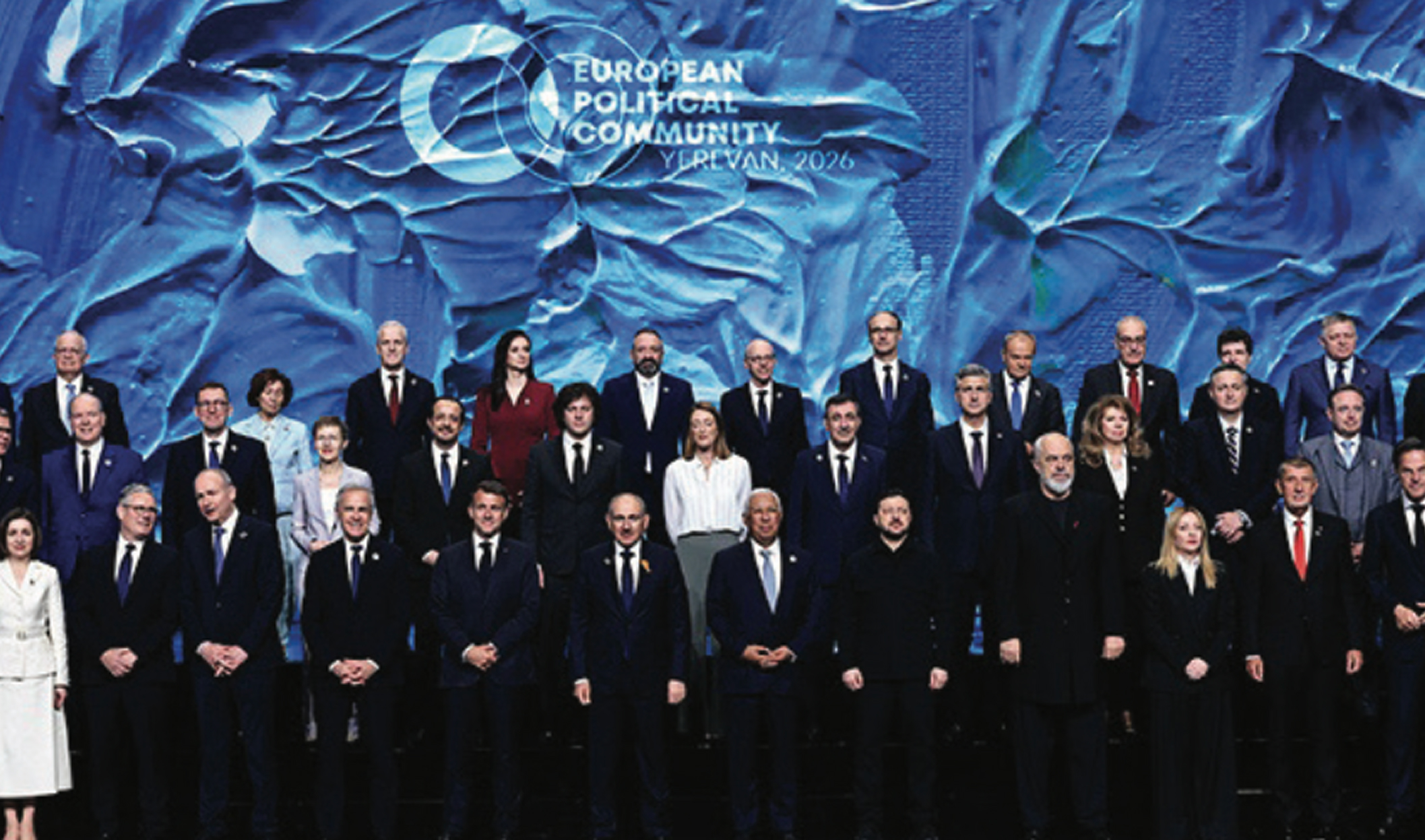

YEREVAN — The 8th Summit of the European Political Community (EPC) officially opened this morning at the Karen Demirchyan Sports and Concert Complex in Yerevan. A formal wel- coming ceremony preceded the event, during which Armenian Prime Minis- ter Nikol Pashinyan greeted dozens of arriving leaders. Among the attendees were French President Emmanuel Macron, the prime ministers of the United King- dom, Italy, Spain, Belgium, the Czech Republic, Norway, and Poland, senior European Union officials, and NATO Secretary General Mark Rutte. For the first time, Canada’s Prime Minister Mark Carney participated in the sum- mit as a guest. Notably, Germany’s Chancellor Olaf Scholz did not attend, citing a heavy workload. Despite being invited, Turkish President Recep Tayyip Erdogan did not attend. Instead, Turkey was rep- resented by Vice President Cevdet Yilmaz—the highest-ranking Turkish official to visit Armenia since 2008. In his opening remarks, Prime Minister Pashinyan stated, “I hope to have the opportunity to visit Azerbai- jan in 2028, when the European Politi- cal Community Summit will be held there.” He also noted that it was the first time Azerbaijan’s President was participating in an event hosted in Ar- menia, albeit via video link. “We are now working closely with Azerbaijan to strengthen and institutionalize peace between our two countries,” he added. Pashinyan also highlighted the significance of the Turkish Vice Presi- dent’s participation, describing it as an important step forward in regional en- gagement. Addressing European leaders via video link from Baku, Azerbaijani President Ilham Aliyev criticized the European Parliament and the Council of Europe for what he described as “pro-Armenian resolutions” and “pro- vocative actions.” He claimed these institutions were “targeting Azerbaijan by spreading misinformation,” noting that 14 such resolutions had been ad- opted between 2021 and 2026, includ- ing one just days before the summit. Ukrainian President VolodymyrZelenskyy also attended the summit for the first time in Armenia. In his re- marks, he urged European leaders to increase pressure on Russia: “We must push Putin toward diplomacy. This summer, Putin must decide whether to escalate the war further or move to- ward diplomacy.” Zelenskyy called for a new package of sanctions targeting Russia’s oil industry, military sector, and banking system. Referring to the planned May 9 parade in Moscow, Zelenskyy added, “For the first time, they will not be able to hold a military parade with equip- ment because they fear drones flying over Red Square. This shows they are not strong right now, and we must con- tinue applying pressure through sanc- tions.” The European Political Commu- nity was established on the initiative of France following Russia’s invasion of Ukraine, and the Russia–Ukraine conflict has remained a central topic at its summits. During the Yerevan gath- ering, President Zelenskyy also held several bilateral meetings. The summit featured panel discus- sions on hybrid threats in Europe, dem- ocratic resilience, and economic secu- rity. This year’s theme was “Building the Future: Unity and Resilience in Eu- rope.” The session was co-chaired by Prime Minister Pashinyan and Euro- pean Council President Antonio Costa. On the sidelines of the event, nu- merous officials—including Arme- nia’s Prime Minister—held bilateral meetings. The summit concluded with a joint statement by Nikol Pashinyan and Antonio Costa, largely ceremonial in nature, reaffirming commitments to peace, regional stability in the South Caucasus, and continued support for Ukraine. The press conference also in- cluded Ireland’s leadership. EPC leaders meet twice a year—in spring and autumn. Previous summits have been hosted by the Czech Repub- lic, Moldova, Spain, the United King- dom, Hungary, Albania, and Denmark. Following Armenia, the next summit will take place in Ireland this autumn, while Azerbaijan is scheduled to host the event in spring 2028.